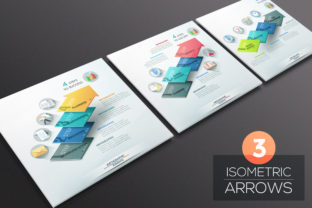
How 3 Isometric Infographic Arrows Clarify Complex Ideas—And Why They Work So Well
What Are Isometric Infographic Arrows, Really?
At first glance, an isometric infographic arrow looks like a sleek, three-dimensional arrow drawn using isometric projection—a technique that renders objects in a fixed 30-degree angle to simulate depth without perspective distortion. When designers use three isometric arrows together, they’re not just adding visual flair—they’re building a structured, spatial narrative. These arrows often represent progression, transformation, or interconnection: one pointing forward (action), one upward (growth), and one looping or branching (feedback or integration).
Unlike flat, two-dimensional arrows—which imply simple direction—isometric arrows convey dimensionality, hierarchy, and relationship. They help viewers mentally “walk through” a process rather than just read about it. This makes them especially powerful in infographics, dashboards, training materials, and pitch decks where clarity and retention matter more than decoration.
Why Three? The Power of Triadic Structure
Three is a foundational number in visual communication—and for good reason. Cognitive psychology tells us that the human brain naturally groups information into chunks of three (a principle known as Miller’s Law). That’s why slogans (“Stop, Look, Listen”), stories (“Beginning, Middle, End”), and models (“Input → Process → Output”) rely on triads.
When applied to isometric arrows, this triadic structure becomes even more potent:
- Sequential flow: Arrow 1 → Arrow 2 → Arrow 3 illustrates a step-by-step journey—like customer onboarding (Sign Up → Explore Features → Achieve Value).
- Systemic balance: Three arrows radiating from a central node show interdependence—e.g., People + Process + Technology in digital transformation.
- Cyclical reinforcement: Arrows forming a triangle or loop visualize feedback loops—common in sustainability frameworks, agile development, or learning cycles.
This isn’t arbitrary design—it’s cognitive scaffolding. Each arrow carries meaning, but together, they form a mental model that sticks.
Real-World Uses Across Industries
You’ve likely seen these arrows in action—even if you didn’t notice the technique. Here’s how they bring clarity to everyday contexts:
In Business Strategy & Operations
A SaaS company might use three isometric arrows to explain its value chain: Automate Tasks (left arrow) → Analyze Data (forward arrow) → Optimize Decisions (upward arrow). The upward tilt visually signals advancement—not just movement, but elevation in capability. Stakeholders instantly grasp cause, effect, and outcome without scrolling through bullet points.
In Education & Learning Design
Teachers use isometric arrow triads to map skill development: Observe → Practice → Teach Others. Because each stage occupies distinct spatial “ground,” learners intuitively understand progression isn’t linear—it’s layered. A student doesn’t just “finish” practice; they ascend to a new level of mastery.
In Sustainability & Social Impact
Nonprofits illustrate systemic change with arrows labeled Community Engagement, Policy Advocacy, and Resource Investment, arranged in a tight triangle. The isometric angle reinforces that no single lever works alone—each depends on the others’ strength and orientation. It subtly challenges the “silver bullet” myth in social change.
Debunking Common Misconceptions
Despite their widespread use, several myths surround isometric infographic arrows:
- “They’re only for tech or design teams.” Not true. Teachers, HR professionals, healthcare educators, and city planners all use them to simplify compliance steps, patient journeys, or infrastructure upgrades.
- “Isometric = complicated to create.” Modern tools like PowerPoint, Canva, and Figma include built-in isometric grids and arrow libraries. You don’t need 3D software—just intentionality about alignment and consistency.
- “More arrows = more clarity.” Quite the opposite. Research shows that beyond three core elements, visual complexity increases cognitive load. Three isometric arrows strike the ideal balance between richness and readability.
How to Use Them Effectively (Without Overdesigning)
Using isometric arrows well isn’t about artistic talent—it’s about purposeful communication. Follow these practical principles:
Start With Intent, Not Aesthetics
Before choosing colors or shadows, ask: What relationship am I showing? Direction? Growth? Reciprocity? Causality? Let the answer dictate arrow placement—not the other way around.
Maintain Visual Consistency
All three arrows should share the same weight, corner radius, shading logic, and isometric angle (typically 30° left/right, 90° vertical). Inconsistency breaks the illusion of shared space—and undermines trust in the message.
Anchor Them in Real Language
An arrow labeled “Innovate” means little. But “Turn Customer Feedback Into Product Updates Within 72 Hours” gives it operational meaning. Pair each arrow with concise, active phrasing rooted in real behavior—not vague aspirations.
Test for Accessibility
Ensure contrast meets WCAG 2.1 standards (at least 4.5:1 for text). Avoid relying solely on color to distinguish arrows—use icons, labels, or stroke patterns too. Remember: isometric depth shouldn’t obscure meaning for screen readers or low-vision users.
Why This Matters Now More Than Ever
We live in an age of attention scarcity and information overload. The average professional receives over 120 emails per day, attends back-to-back virtual meetings, and scrolls through fragmented updates across Slack, Teams, and internal wikis. In that environment, clarity isn’t a nice-to-have—it’s a competitive advantage.
Three isometric infographic arrows cut through noise by doing what words alone struggle to do: show scale, sequence, and significance at a glance. They turn abstract strategy into something tangible—something you can point to, discuss, and remember. That’s why forward-thinking organizations embed them in onboarding kits, investor briefings, and even public-facing climate reports.
And it’s not just about efficiency. There’s a subtle psychological benefit: when people see ideas rendered in balanced, dimensional form, they feel more confident in their understanding. That confidence fuels better decisions, faster alignment, and stronger collaboration.
Building Your Own—A Quick Starter Framework
Ready to try it? Here’s a repeatable 4-step approach:
- Identify your core concept (e.g., “improving remote team engagement”).
- Name the three essential phases or pillars (e.g., Connect, Contribute, Celebrate).
- Assign spatial logic: Which phase initiates action? Which reflects growth? Which closes the loop? Sketch rough placements—forward, up, or angled inward.
- Add minimal context: One verb + object per arrow (e.g., “Host Weekly Voice Chats”, “Share Wins in #kudos”, “Rotate Recognition Spotlight”).
No special software needed. Start with a free isometric grid template, use bold sans-serif labels, and keep colors purposeful—not decorative.
Final Thought: Clarity Is a Skill—And These Arrows Are a Tool
Three isometric infographic arrows aren’t magic. They won’t fix unclear thinking or poorly defined goals. But when grounded in sound strategy and user-centered intent, they become a remarkably reliable tool for turning ambiguity into insight.
Whether you're explaining cybersecurity protocols to new hires, mapping a student’s literacy journey, or pitching an AI ethics framework to executives—you’re not just sharing information. You’re inviting someone into a shared mental model. And in that invitation, three well-placed, thoughtfully labeled arrows can say more than a thousand words ever could.