Landing Page Template: A Practical Guide for Informed Decisions
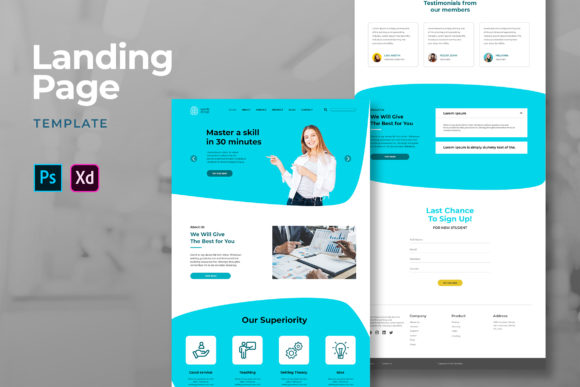
A Landing Page Template is a pre-designed, reusable layout—typically built with HTML, CSS, and sometimes lightweight JavaScript—that serves as a starting point for creating a focused, conversion-oriented web page. Unlike a full website or generic webpage, it’s intentionally streamlined: one primary goal, minimal navigation, and deliberate visual hierarchy. It’s not software, a SaaS tool, or a theme marketplace; it’s a structural foundation—often delivered as downloadable code files or integrated into site builders—that helps teams launch targeted campaigns faster without sacrificing control or performance.
What Sets a Landing Page Template Apart
Its distinction lies in purpose and scope. A Landing Page Template is narrowly scoped—not meant to scale into a multi-page site, but optimized for immediacy. It usually includes sections like a headline with clear value proposition, supporting subhead, brief benefit-driven copy, a single prominent call-to-action (CTA), social proof elements (testimonials, logos), and a simple form. Design-wise, it prioritizes readability, mobile responsiveness, and fast load times—often avoiding heavy frameworks or bloated dependencies.
This differs meaningfully from broader alternatives. A website theme, for example, provides navigation menus, blog layouts, footer structures, and multiple page types—but introduces complexity and overhead when you only need one page. A drag-and-drop landing page builder offers real-time editing and integrations but often locks users into proprietary platforms, limits customization, and may slow down pages due to injected scripts. In contrast, a Landing Page Template gives developers, marketers, and small business owners direct access to clean, editable source code—no vendor lock-in, no monthly fee, and full control over hosting, tracking, and performance.
When a Landing Page Template Fits—and When It Doesn’t
A Landing Page Template works best when speed, simplicity, and autonomy matter more than ongoing editing by non-technical users. Consider a seasonal product launch: a marketing team needs a high-converting page live in under 48 hours. Using a well-structured Landing Page Template, they can replace placeholder text and images, connect a lightweight form to their email service, and deploy via GitHub Pages or Netlify—all without involving engineering. The result is fast, secure, and fully owned.
But it’s not universally appropriate. If your team relies on frequent A/B testing of headlines, CTAs, and layouts—and lacks front-end expertise—a template alone won’t suffice without additional tooling or developer support. Similarly, if you need dynamic content (e.g., real-time inventory, personalized pricing), a static Landing Page Template requires backend integration work that may outweigh its initial time savings.
It also doesn’t replace strategic thinking. A beautifully coded template won’t convert if the offer is unclear, the audience isn’t well-defined, or the CTA doesn’t align with user intent. The template supports execution—it doesn’t substitute for research, messaging clarity, or funnel alignment.
Key Strengths and Realistic Tradeoffs
Strengths:
- Performance-first design: Most modern templates avoid unnecessary libraries, resulting in sub-second load times—critical for SEO and bounce rate.
- Full ownership and portability: You host it where you choose, update it how you like, and migrate it without platform restrictions.
- Predictable maintenance: With limited moving parts, updates are infrequent and straightforward—no plugin conflicts or version drift.
- Cost efficiency: One-time effort or modest investment, with no recurring fees or usage-based pricing.
Tradeoffs:
- Editing friction for non-developers: Updating copy or images typically requires basic HTML/CSS knowledge—or coordination with someone who has it.
- Limited interactivity out of the box: Features like multi-step forms, live chat, or embedded calendars usually require custom implementation.
- No built-in analytics or A/B tools: You’ll integrate Google Analytics, Hotjar, or Optimizely manually—flexible, but not automatic.
- Design consistency across campaigns isn’t guaranteed: Without a design system or shared component library, each template may feel visually disconnected from your brand’s broader digital presence.
Comparing Approaches: Where Does the Template Fit?
Think of the Landing Page Template as one option on a spectrum of execution methods—each with different tradeoffs in control, speed, scalability, and skill requirements.
At one end: Custom-coded landing pages. Built from scratch for maximum performance and uniqueness, but requiring significant time and technical depth. A Landing Page Template sits just left of this—offering much of the same control and quality, but with scaffolding that reduces boilerplate work.
In the middle: No-code builders (like Unbounce or Leadpages). These prioritize ease of use and rapid iteration but often introduce latency, limit design flexibility, and tie you to their infrastructure. A Landing Page Template trades off some convenience for greater transparency and long-term adaptability.
At the other end: Website themes or CMS plugins. Useful when landing pages must coexist within an existing WordPress or Shopify site—but risk diluting focus with global navigation, inconsistent styling, or slower performance due to theme bloat.
The choice isn’t about “best,” but about alignment. If your team values auditability, lean infrastructure, and long-term maintainability—and has at least occasional access to front-end skills—the Landing Page Template becomes a highly practical anchor.
Practical Evaluation Criteria
Before adopting or building a Landing Page Template, consider these decision factors:
- Team capability: Who will update it? If updates happen weekly and require code changes, ensure those skills exist—or budget for light developer support.
- Integration needs: Does it need to connect to your CRM, email service, or analytics stack? Verify the template supports clean, standards-based form handling and script injection.
- Performance baseline: Run a demo version through Lighthouse or WebPageTest. Look for scores above 90 on performance and accessibility—and verify it meets Core Web Vitals thresholds.
- Mobile behavior: Test interactions on real devices—not just emulators. Tap targets should be appropriately sized, spacing legible, and forms functional without zooming.
- Licensing and attribution: Review usage terms. Some free templates require attribution; others restrict commercial use. Choose one aligned with your deployment context.
Real-World Use Cases That Benefit Most
A local service business running Google Ads for “emergency plumbing repair” might use a Landing Page Template to create a dedicated, fast-loading page with clear contact options, trust badges, and location-specific copy—distinct from their main site. It converts better because it removes distractions and speaks directly to urgent intent.
A B2B SaaS company launching a new feature could deploy a Landing Page Template to collect early sign-ups—embedding a simple form linked to their marketing automation platform. Because it’s lightweight and self-hosted, they avoid third-party tracking delays and retain full data ownership.
An indie creator promoting a limited-time workshop might pair a Landing Page Template with a headless CMS (like Sanity or Contentful) to allow non-technical team members to update dates, pricing, and FAQs—keeping the front-end performant while adding editorial flexibility.
Making the Call: Is This the Right Fit?
A Landing Page Template is most valuable when you prioritize speed of deployment *and* long-term control—without needing constant, complex updates. It suits teams comfortable with basic code, those managing multiple campaigns across domains or subdomains, and organizations committed to privacy, performance, and infrastructure transparency.
It’s less ideal if your workflow depends on visual editors, if your landing pages evolve daily with dozens of variants, or if your team lacks any capacity—even occasional—to review or tweak HTML and CSS.
Ultimately, the Landing Page Template isn’t a shortcut—it’s a deliberate choice. It reflects a preference for intentionality over convenience, clarity over clutter, and sustainability over quick wins. When matched to the right context, it delivers measurable advantages: faster load times, stronger SEO signals, higher conversion rates, and full operational independence.