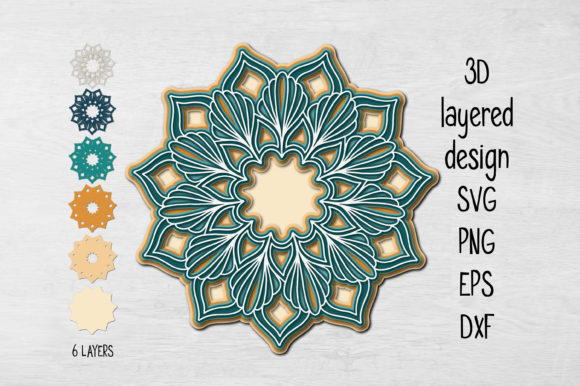
3D Layered Mandala: A Convergent Medium for Design, Therapy, Education, and Digital Innovation
The 3D layered mandala is more than an aesthetic evolution of the traditional circular symbol—it’s a multidimensional interface where geometry, perception, material science, and human cognition intersect. Unlike flat, two-dimensional mandalas rooted in spiritual iconography, this form introduces depth, interactivity, and structural intentionality through stacked, aligned, or offset planar layers. Each layer may be transparent, opaque, textured, or dynamically responsive—enabling light modulation, shadow play, kinetic movement, or digital augmentation. Its emergence reflects broader shifts across design disciplines: from static representation to experiential systems, from symbolic abstraction to functional embodiment.
How Depth Transforms Meaning and Function
At its core, the 3D layered mandala redefines how symmetry operates in space. Traditional mandalas rely on radial balance within a single plane—think of Tibetan sand paintings or Islamic zillij tilework. The 3D variant preserves that radial logic but distributes it across vertical strata. One layer might contain a foundational eight-petal lotus; the next, a concentric ring of fractal branching; the third, a lattice of interlocking hexagons—all precisely registered yet visually distinct when viewed obliquely or lit from specific angles.
This spatial layering enables new modes of engagement. In architectural models, designers embed 3D layered mandalas into façade systems to control solar gain—outer layers filter direct sunlight while inner layers diffuse ambient light. In physical therapy settings, occupational therapists use tactile mandalas with graduated layer heights to support fine motor rehabilitation: patients trace paths across rising contours, reinforcing proprioceptive feedback alongside visual tracking.
Education: Spatial Reasoning and Cross-Disciplinary Literacy
Classrooms increasingly adopt 3D layered mandalas as pedagogical tools—not as decorative artifacts, but as manipulatives that integrate mathematics, art, and systems thinking. Middle school students assemble laser-cut acrylic layers representing Fibonacci sequences, then rotate them to observe emergent interference patterns. High school biology classes map cellular organelles onto concentric mandala layers, using transparency gradients to indicate membrane permeability. The structure scaffolds abstract concepts without oversimplification: learners see hierarchy, scale, and relationality—not just isolated facts.
Research from the University of Helsinki’s Learning Environments Lab observed measurable gains in spatial visualization test scores among students who regularly interacted with modular 3D mandala kits over a 10-week period—outperforming peers using standard 2D diagrams by 27%. The effect was most pronounced in learners previously identified as “spatially hesitant,” suggesting the format lowers cognitive barriers to complex system comprehension.
Creative Practice: From Analog Craft to Generative Systems
For artists and designers, the 3D layered mandala serves as both constraint and catalyst. Ceramicist Lena Cho constructs kiln-fired porcelain mandalas where each layer represents a geological stratum—firing temperatures and glaze chemistries vary per tier, producing subtle color shifts that only emerge after cooling. Meanwhile, generative coder Ravi Mehta uses Processing scripts to output CNC-ready layer files, where algorithmic rules govern rotational offsets, thickness tapering, and edge chamfering. His latest series responds in real time to environmental audio feeds, adjusting layer alignment based on ambient decibel levels—a quiet room yields tightly nested symmetry; louder environments introduce deliberate, rhythmic misalignments.
What unites these approaches is intentionality of separation. Each layer carries semantic weight—not merely visual interest. In branding work, studios deploy 3D layered mandalas to represent organizational values: one layer for community (open, porous geometry), another for innovation (dynamic, non-repeating tessellation), a third for sustainability (biomimetic curves and recycled-material indicators). Stakeholders don’t just see a logo—they navigate a value architecture.
Wellness and Clinical Contexts: Beyond Ornamentation
In clinical psychology and neurorehabilitation, evidence is mounting for structured visual complexity as a regulatory tool. Unlike passive stimuli, the 3D layered mandala invites active scanning—eyes move not just outward from center, but up and down across planes, recalibrating depth perception and attentional stamina. A 2023 pilot study at Johns Hopkins Medicine used backlit acrylic mandalas with three variable-opacity layers during anxiety reduction sessions. Participants reported significantly lower subjective units of distress (SUD) scores after five minutes of guided layer-focused breathing compared to standard mindfulness audio alone.
Crucially, therapeutic efficacy correlates with layer count and perceptual demand—not ornateness. Mandalas with four highly differentiated layers (e.g., matte metal base + frosted glass mid-layer + etched polymer top) showed stronger grounding effects than those with six visually similar layers. This underscores a key principle: the 3D layered mandala’s power lies in discernible, meaningful distinction—not maximal complexity.
Material and Technical Considerations for Implementation
Bringing a 3D layered mandala to life requires thoughtful alignment of intent, medium, and method. Laser cutting works exceptionally well for rigid, precise layers in wood, acrylic, or thin metals—but introduces thermal stress points that affect long-term stability in humid environments. For large-scale installations, vacuum-formed polycarbonate offers impact resistance and optical clarity, though layer registration demands custom jigs. Digital fabrication adds another dimension: multi-material 3D printers can embed conductive traces between layers for touch-responsive interfaces, while UV-curable resins allow for gradient translucency within a single printed layer—blurring the line between “layer” and “gradient.”
One underdiscussed factor is viewing context. A mandala designed for wall-mounted display behaves differently than one intended for tabletop rotation or overhead projection. Lighting direction dramatically alters perception: side lighting emphasizes contour and relief; backlighting reveals transparency relationships and shadow layering; diffused overhead light flattens depth cues. Professionals implementing these forms benefit from prototyping under target conditions—not just in ideal studio lighting.
Emerging Trends and Interdisciplinary Crossovers
Three converging trends are expanding the scope of the 3D layered mandala beyond niche applications:
- Responsive Architecture: Smart glass layers integrated into building envelopes shift opacity and pattern alignment in response to real-time weather data—transforming static façades into dynamic, climate-responsive mandalas that modulate heat gain and daylight penetration.
- Neuro-Informed Design: Collaborations between neuroscientists and industrial designers are yielding mandalas calibrated to specific brainwave states. EEG-informed layer spacing and contrast ratios aim to support focus (beta-wave coherence) or restorative downtime (alpha-theta transitions), moving beyond aesthetics into biometrically grounded environmental design.
- Open-Source Fabrication Libraries: Communities like Mandala.Design/Open host parametric templates where users adjust variables—layer count, radial frequency, thickness decay rate—and generate ready-to-cut files. These aren’t presets; they’re editable systems, fostering literacy in geometric logic rather than passive consumption.
Notably, commercial adoption is growing cautiously. Major museum gift shops now stock limited-edition 3D layered mandalas made from reclaimed ocean plastics—each layer cast from a different recovered polymer type, labeled with marine debris origin data. This transforms symbolic form into tangible environmental narrative, where material provenance becomes part of the mandala’s meaning.
Key Considerations Before Adoption
Despite its versatility, the 3D layered mandala isn’t universally appropriate. Its strengths lie in contexts demanding layered understanding, intentional pacing, or embodied interaction. It falters when speed, simplicity, or broad scalability are primary goals. A healthcare app icon shouldn’t be a 3D layered mandala; a hospital wayfinding kiosk’s central motif might benefit profoundly from one—especially if paired with haptic feedback on layer selection.
Two practical thresholds matter most:
- Alignment Precision: Sub-millimeter registration errors compound across layers, causing visual vibration or unintended moiré effects. Budget for alignment hardware (e.g., dowel pins, optical registration marks) even in low-fidelity prototypes.
- Perceptual Load Management: More layers don’t always equal deeper meaning. Test with representative users: Can they distinguish at least three layers without instruction? Do transitions between layers feel intentional or arbitrary? If not, simplify before adding complexity.
Finally, avoid conflating novelty with value. A 3D layered mandala embedded in a corporate presentation deck without narrative integration becomes visual noise. Its power emerges when each layer maps to a concrete concept, process stage, or stakeholder perspective—and when viewers are invited to explore that mapping, not just admire the result.
Why This Form Endures Beyond Trend Cycles
The longevity of the 3D layered mandala stems from its rare capacity to serve multiple epistemologies simultaneously. To a mathematician, it’s a physicalized manifold. To a teacher, it’s a scaffold for conceptual layering. To a patient in recovery, it’s a stable anchor amid neurological flux. To a city planner, it’s a model for infrastructural hierarchy—transport, utilities, green space—stacked with clear dependencies.
Its resilience lies in fidelity to first principles: symmetry as organizing logic, repetition as memory aid, variation as meaning marker, and depth as metaphor made tangible. As digital interfaces grow flatter and faster, there’s renewed cultural appetite for objects and systems that reward sustained, multi-sensory attention—where looking longer reveals more, and making reveals understanding. The 3D layered mandala doesn’t resist technological acceleration; it provides counterweight, depth, and deliberation where they’re most needed.
Whether rendered in hand-carved walnut, algorithmically generated glass, or AR-enabled holography, its function remains consistent: to make complexity navigable, relationships visible, and presence palpable—one intentional layer at a time.