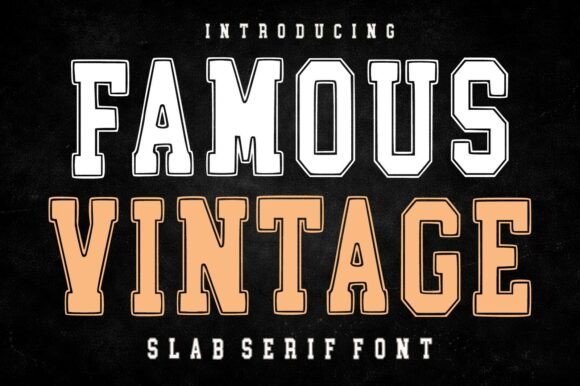
Famous Vintage: A Curated Resource for Timeless Typography and Design Inspiration
Famous Vintage isn’t a font foundry, a stock photo platform, or a SaaS tool—it’s a quietly influential archive of typographic artifacts, print ephemera, and mid-century design language. Built over years of deliberate curation rather than algorithmic aggregation, it offers high-resolution scans, contextual notes, and clean digital access to lettering styles from 1920–1975: advertising type specimens, packaging labels, hand-lettered signage, magazine mastheads, and press proofs. Its value lies not in novelty, but in fidelity—preserving visual nuance that’s often lost in reinterpretations or AI-generated approximations.
What Sets Famous Vintage Apart From Generic Retro Collections
Many resources claim “vintage” appeal but deliver stylized filters, low-res JPEGs, or derivative fonts with inconsistent spacing and inaccurate weight distribution. Famous Vintage avoids those pitfalls by prioritizing source integrity. Each entry includes provenance where known (e.g., “Lithograph from Chicago-based R. H. Donnelley, 1948”), physical condition notes (“slight ink bleed on lower right quadrant”), and technical metadata (scan resolution, color profile, original medium). This level of documentation supports informed decision-making—not just aesthetic selection.
Unlike crowdsourced archives or AI-curated feeds, Famous Vintage is edited by a small team with backgrounds in graphic design history, commercial printing, and archival conservation. That shows in the consistency of tagging: terms like “hot metal composition,” “letterpress impression depth,” or “ben-day dot density” appear only when verifiable—not as decorative SEO bait. The result is a resource that rewards close looking and supports precise application.
Practical Use Cases Across Professional Workflows
For designers building brand identities with historical grounding—say, a craft distillery launching a bourbon line inspired by 1930s apothecary labeling—Famous Vintage provides authentic reference points beyond generic “retro” palettes. A designer can study how serif weights were balanced against thick sans-serif subheads in actual pharmacy signage, then adapt proportion and contrast accordingly—not copy, but translate.
Freelancers creating editorial illustrations for publications like The Atlantic or Wired use Famous Vintage to ground conceptual work in tangible precedent. One illustrator recently referenced a 1956 Fortune magazine cover’s halftone screen frequency and type hierarchy to inform a data visualization series—achieving period-appropriate texture without pastiche.
Educators find it especially useful for teaching typography fundamentals. Rather than presenting fonts in isolation, instructors pull full spreads showing how type interacted with photography, paper grain, and binding constraints. Students observe how leading changed across folded brochure sections or how ink spread affected x-height legibility at small sizes—lessons no modern font preview can replicate.
Quality, Consistency, and Real-World Reliability
All assets are scanned at minimum 600 DPI in 16-bit TIFF format, then converted to web-optimized PNG or JPEG only after manual color correction against calibrated monitors and printed proofs. There’s no auto-enhancement: if a scan shows subtle yellowing from aging newsprint, that’s preserved—not “fixed” into artificial neutrality. That honesty matters when matching physical production (e.g., foil stamping on recycled board) to digital mockups.
Navigation is deliberately restrained. There’s no infinite scroll or recommendation engine. Instead, users browse by decade, medium (e.g., “matchbook covers,” “catalogue inserts”), or typographic category (“geometric sans,” “transitional serifs”). Filters support Boolean combinations—e.g., “1940s + letterpress + pharmaceutical.” This precision reduces time spent sifting, especially for professionals under deadline pressure.
Updates are infrequent but meaningful—typically 12–18 new entries per quarter, each accompanied by a short contextual essay. Recent additions included a set of 1952 travel agency brochures from Miami Beach, highlighting how tropical motifs influenced condensed display lettering. No filler. No duplication. No trend-chasing.
Who Benefits Most—and When It’s Not the Right Fit
Famous Vintage serves professionals who need verifiable reference—not mood boards. That includes:
- Brand strategists developing heritage-aligned extensions for legacy companies;
- Print production managers verifying historical ink behavior for specialty substrates;
- Typography researchers cross-referencing specimen books with surviving commercial applications;
- UX writers studying how mid-century instructional graphics handled hierarchy and scannability;
- Archival publishers restoring out-of-copyright materials with typographic accuracy.
It’s less suited for teams needing rapid-turnaround social media templates, AI-assisted logo generation, or scalable vector fonts ready for variable-weight interpolation. Famous Vintage doesn’t provide OTF/TTF files—it provides evidence. If your goal is to replicate a 1947 department store logo exactly, you’ll need to digitize or commission custom lettering based on the source. That’s intentional: it preserves the distinction between inspiration and implementation.
Integration Into Existing Tools and Workflows
No plugin or API exists—and that’s by design. Users download individual assets and import them directly into Adobe Creative Cloud, Affinity Suite, Figma (via image layers), or even Procreate for hand-traced reinterpretation. Because files retain embedded ICC profiles and EXIF-like metadata, color management remains predictable across devices. Designers report fewer surprises when moving from screen to press proof compared to using untagged web images.
For collaborative projects, teams often create shared folders labeled by campaign phase—e.g., “Famous Vintage – Research Phase – Beverage Clients.” That keeps references contextually anchored, avoiding the drift that happens when vintage assets get siloed in generic “inspiration” drives with no sourcing or usage notes.
Limitations Worth Acknowledging
Famous Vintage doesn’t host audio, film, or 3D packaging scans. Its scope is intentionally two-dimensional and print-centric. While some entries include related product photography (e.g., a soda bottle alongside its label), those are supplementary—not core. It also lacks multilingual coverage beyond English, French, German, and Spanish sources—reflecting the geographic focus of its curatorial network.
Licensing is straightforward but not flexible: all assets are licensed for editorial and commercial use under a perpetual, worldwide, non-exclusive agreement—no subscription, no seat limits—but resale or redistribution of raw files is prohibited. That protects both the archive’s sustainability and the integrity of its sourcing. For agencies billing clients on a project basis, this eliminates per-seat overhead without compromising legal clarity.
Making It Work for Your Next Project
Start narrow. Instead of searching “vintage food,” try “1950s canned goods label + lithograph.” Notice how kerning tightens around ampersands in stacked product names, or how stroke contrast shifts at different point sizes. Then ask: What problem was that solving? Legibility at arm’s length? Shelf differentiation? Regulatory compliance?
If you’re adapting a Famous Vintage element into a live brand system, test it at multiple scales and substrates early—even before finalizing color. A type treatment that reads cleanly on matte-coated stock may vanish on kraft paper without adjusted weight or tracking. The archive gives you the “what”; your judgment determines the “how much” and “where.”
Famous Vintage won’t replace your font library or design system. But it does something rarer: it anchors creative decisions in material reality. In an era where generative tools blur the line between reference and output, having a source you can verify, cite, and return to—without algorithmic interference—isn’t nostalgic. It’s operational rigor.