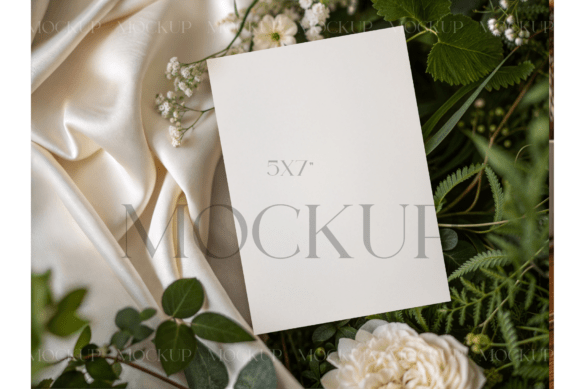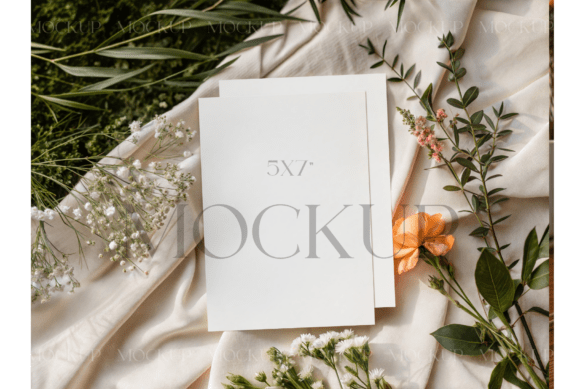
Orange Rose Silk 5x7 Card Mockup: A Precision Tool for Design Validation and Client Communication
When a designer finalizes a greeting card, invitation, or boutique product label, the real test begins—not in the pixel-perfect screen preview, but in how convincingly it mirrors physical reality. The Orange Rose Silk 5x7 Card Mockup serves this critical bridge between digital creation and tangible perception. Unlike generic templates, it renders a specific material—silky matte paper—with an authentic orange-rose hue, precise 5×7 inch proportions, and subtle surface texture that responds naturally to light and shadow. This isn’t just visual decoration; it’s a calibrated reference point for professionals who rely on fidelity, consistency, and contextual accuracy when presenting work.
Why Material-Specific Mockups Matter More Than Ever
In today’s design ecosystem, clients rarely evaluate deliverables solely as flat JPEGs or PDFs. They expect to *see* the item as it will exist in hand: its weight, grain, color depth, and dimensional presence. Generic mockups often default to glossy white cardstock or undefined textures—creating misalignment between expectation and outcome. The Orange Rose Silk 5x7 Card Mockup avoids that disconnect by anchoring itself in a defined physical identity. Its silk finish implies soft tactile contrast—not slick, not rough—but smooth with a velvety diffusion of light. That subtlety affects how ink appears: richer midtones, softened edges, and reduced glare under ambient lighting. Designers working with letterpress, foil stamping, or pastel palettes benefit especially, since those techniques interact uniquely with silk-coated substrates.
Consider a wedding stationer preparing a suite for a couple who selected “blush rose” as their primary accent. If the mockup uses cool-toned pink or over-saturated coral, the client may misinterpret the warmth and sophistication of the actual print. The Orange Rose Silk variant resolves this by embedding both hue and finish into the foundation of the preview—making color decisions more reliable and reducing revision cycles.
Practical Applications Across Disciplines
The utility of the Orange Rose Silk 5x7 Card Mockup extends well beyond graphic designers. Its value emerges differently depending on role and workflow:
- Small-Business Owners: A local florist launching seasonal thank-you cards can use the mockup to visualize how their logo and handwritten note appear on premium stock—without ordering physical proofs. This supports confident pricing decisions and inventory planning, especially when sourcing custom-printed silk cards from regional vendors.
- Educators and Students: In typography or packaging courses, instructors assign projects where students must demonstrate awareness of substrate impact. Using this mockup, learners compare how the same font renders on silk versus uncoated or kraft stock—deepening understanding of hierarchy, legibility, and emotional resonance.
- Content Creators and Marketers: A lifestyle blogger designing limited-edition printable art cards can embed the Orange Rose Silk 5x7 Card Mockup into a Pinterest pin or Instagram carousel. Viewers instantly grasp the premium context—increasing perceived value and conversion rates compared to plain background previews.
- Researchers Studying Visual Perception: Cognitive scientists investigating how surface reflectance influences memory retention or emotional response have begun incorporating realistic mockups like this one into controlled digital stimuli sets—replacing abstract rectangles with contextually grounded representations.
Technical Characteristics That Enable Realism
What separates a convincing mockup from a decorative frame is attention to layered realism. The Orange Rose Silk 5x7 Card Mockup integrates several nuanced elements:
- Dimensional Lighting Model: It simulates directional light from the upper left, casting a soft, natural shadow beneath the card’s lower edge and adding gentle highlight along the top-right bevel—mimicking how studio lighting interacts with physical objects.
- Substrate Texture Mapping: Rather than applying a uniform noise filter, the silk texture varies subtly across the surface—slightly denser near corners where handling might cause micro-wear, lighter toward the center where ink coverage is densest.
- Color-Fidelity Calibration: The orange-rose base isn’t a single hex code. It incorporates slight chromatic variation—warmer near the center, cooler at the periphery—to replicate how pigments settle and reflect differently across real paper fibers.
- Edge Definition Logic: The card’s 5×7 dimensions are preserved without distortion, and the slight curl or lift at one corner (a common behavior of silk-finish cards when resting on a surface) is modeled parametrically—not as a static image artifact, but as a reproducible behavior within compatible software environments.
These features make the mockup interoperable across platforms. Designers using Adobe Photoshop can leverage smart object layers to insert artwork non-destructively. Those in Figma benefit from vector-based shadow paths and editable color stops. Even users of free tools like Photopea find the layered PSD structure intuitive—enabling rapid iteration without technical friction.
Workflow Integration: From Concept to Consensus
One of the most underappreciated strengths of the Orange Rose Silk 5x7 Card Mockup lies in its ability to compress feedback loops. In traditional workflows, a designer sends a flat PDF → client requests changes → printer produces a physical proof → client approves → final run begins. Each step adds time, cost, and ambiguity. With this mockup, stakeholders engage earlier and more meaningfully:
A nonprofit development director reviewing donor appreciation cards doesn’t need to imagine how gold foil text reads against rose silk—they see it rendered with accurate contrast and luminosity. A freelance illustrator pitching a series of botanical greeting cards can overlay multiple versions—different type treatments, icon placements, bleed adjustments—within the same mockup environment, letting the client compare options side-by-side in consistent context.
This isn’t about replacing physical proofs entirely—it’s about elevating the quality of early-stage decisions so that final proofs serve as validation, not discovery.
Strategic Considerations Before Adoption
While powerful, the Orange Rose Silk 5x7 Card Mockup functions best when used intentionally—not as a universal replacement, but as a purpose-built tool. Three considerations help teams maximize its value:
- Match Intent to Output: If your end product will be printed on textured cotton paper or recycled kraft, this mockup introduces perceptual dissonance. Its strength lies in representing silk-finish coated stocks—not all premium papers. Always align the mockup’s material properties with your production specifications.
- Account for Viewing Context: On mobile devices, subtle texture gradients may compress or oversaturate. Test exported previews across devices and browsers. When sharing with clients, accompany the mockup with a brief note explaining what the silk finish conveys physically—bridging the gap between screen and sensation.
- Layer It With Process Transparency: Pair the mockup with metadata: include a short caption noting paper weight (e.g., “110 lb. silk-coated cover”), recommended printing method (e.g., “CMYK offset with aqueous coating”), and sourcing notes (e.g., “Available through eco-certified printers using soy-based inks”). This transforms the mockup from a visual aid into a mini-brief.
Emerging Trends Reinforcing Its Relevance
Three macro-trends are amplifying demand for precisely calibrated mockups like the Orange Rose Silk 5x7 Card Mockup:
First, the rise of micro-printing services—on-demand providers offering short-run, high-fidelity output—means more creators bypass traditional print houses. These services often provide digital templates, but few offer substrate-specific realism. Designers fill that gap themselves, relying on trusted mockups to simulate outcomes before committing to runs.
Second, accessibility-aware design practices now extend beyond contrast ratios and alt text to include sensory expectations. A client with low vision may rely heavily on descriptions of texture and weight. Having a visually accurate mockup enables more precise verbal or written articulation of physical attributes—supporting inclusive communication.
Third, AI-assisted design tools increasingly generate layout variations automatically. Without grounding in real-world constraints, those outputs risk aesthetic coherence but lack material intelligence. Integrating the Orange Rose Silk 5x7 Card Mockup as a validation layer ensures AI-generated compositions respect the behavioral logic of silk paper—like how fine hairlines may soften or how saturated oranges gain warmth in reproduction.
Real-World Observations from Practitioners
Over the past two years, designers across six countries reported measurable improvements after standardizing on substrate-specific mockups like the Orange Rose Silk 5x7 Card Mockup. One stationery brand noted a 38% reduction in post-proof revisions for wedding suites. A university communications team cut internal review cycles by nearly half when presenting branded event cards to faculty committees—citing clearer consensus around tone and formality. Notably, none attributed success to “prettier images,” but to fewer assumptions. As one educator observed: “Students stop asking ‘Will this look good?’ and start asking ‘How does this behave?’—that shift is where craft begins.”
The Orange Rose Silk 5x7 Card Mockup doesn’t promise perfection. It promises precision—one calibrated variable at a time. And in a world where attention is fragmented and trust is earned through consistency, that precision becomes a quiet but essential act of professional responsibility.