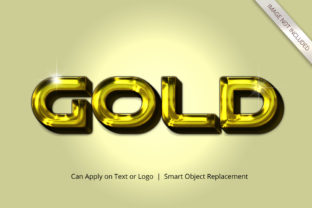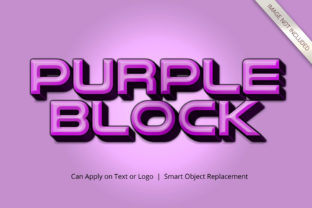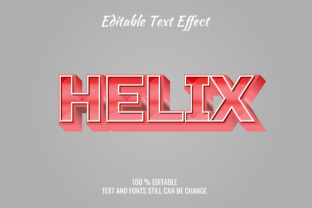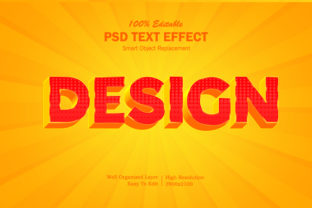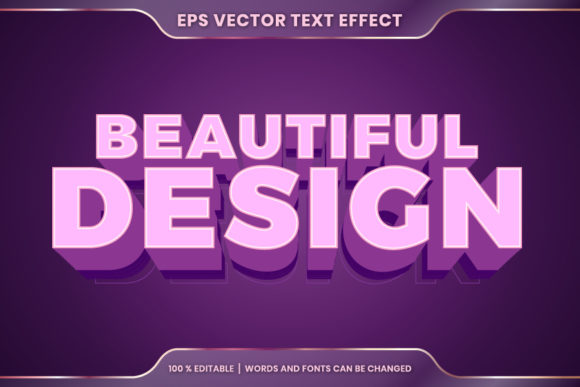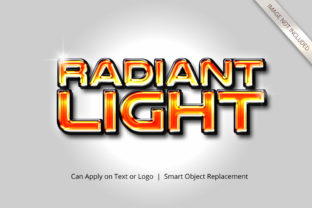
Realistic 3D Text Mockup Effect Style
The Realistic 3D Text Mockup Effect Style refers to a design technique that renders text as if it exists physically in three-dimensional space—complete with lighting, shadows, material texture, depth perception, and environmental context. Unlike basic extruded or beveled text, this style integrates photorealistic rendering principles: subtle ambient occlusion, directional light falloff, surface reflectivity (e.g., brushed metal, matte plastic, or glossy enamel), and realistic interaction with a background scene—such as a desk surface, studio backdrop, or product packaging environment.
This approach is commonly implemented using layered PSD templates, specialized mockup generators, or 3D software like Blender, Cinema 4D, or Adobe Dimension. The output is typically a static image or sequence intended for presentation—not interactive 3D navigation—but designed to convey tangible presence and spatial authenticity.
Why Consider This Style?
Designers, marketers, and content creators often explore the Realistic 3D Text Mockup Effect Style when visual credibility matters more than stylistic abstraction. For example, a branding team evaluating logo treatments may need to assess how a wordmark would appear on physical signage, packaging, or promotional merchandise. Similarly, UI designers prototyping app onboarding screens might use this effect to simulate how a headline appears on a device screen under natural lighting conditions.
Interest also arises from practical communication needs: stakeholders unfamiliar with typography or digital rendering may better interpret scale, hierarchy, and material intent through realism. A client reviewing a campaign concept may respond more confidently to a mockup showing text embossed on a leather-bound notebook than to a flat vector preview—even if both represent the same typographic choice.
Key Benefits and Practical Advantages
One primary benefit is contextual fidelity. By placing text within a believable environment—complete with perspective-correct shadows and surface interaction—the viewer gains immediate insight into proportion, contrast, and legibility at intended size and distance. This helps surface issues early: a font that looks elegant in isolation may lack weight when rendered as engraved stainless steel on a reflective surface.
Another advantage is consistency across deliverables. When multiple assets (e.g., social banners, email headers, print brochures) must share a unified typographic identity, applying the same Realistic 3D Text Mockup Effect Style ensures visual continuity—even if final implementations vary in medium or technology.
Additionally, this style supports rapid iteration during concept development. High-quality mockup templates allow non-3D specialists to test variations of color, angle, material, and lighting without deep technical investment. That lowers the barrier to exploring tone and brand expression—say, comparing a soft, diffused glow against a sharp, directional highlight—before committing to production assets.
Tradeoffs and Important Considerations
A key tradeoff is flexibility versus fidelity. Highly realistic mockups often rely on fixed perspectives and pre-baked lighting. Adjusting viewpoint or repositioning text after rendering usually requires returning to source files or rebuilding the scene—unlike flat vector graphics, which remain fully editable at any stage. This can slow down late-stage revisions.
Performance and accessibility are also relevant. While the final output is typically a raster image, generating high-resolution mockups demands computational resources—especially when simulating complex materials like frosted glass or weathered concrete. Teams with limited hardware or tight deadlines may find batch processing time prohibitive.
There’s also a perceptual risk: overemphasis on realism can unintentionally shift focus away from core typographic qualities—kerning, rhythm, x-height—toward surface aesthetics. A visually striking mockup might mask poor readability in real-world use, particularly at small sizes or low contrast. Users should always validate legibility separately using objective metrics (e.g., WCAG contrast ratios) and real-device testing.
When It’s a Strong Fit
The Realistic 3D Text Mockup Effect Style works well in scenarios where physicality and environmental integration are central to decision-making. Examples include:
- Presenting packaging concepts where text appears on curved surfaces, embossed foil, or textured substrates;
- Developing signage systems requiring assessment of visibility under varied lighting (e.g., storefronts, wayfinding);
- Creating pitch decks for clients who prioritize tangible outcomes over abstract design language;
- Supporting internal alignment among cross-functional teams—including manufacturing, procurement, or retail operations—who rely on spatial cues to estimate feasibility or cost.
In these cases, the added layer of realism serves functional evaluation—not just aesthetic appeal.
When Alternatives May Be More Appropriate
For early-stage ideation or typography-focused critique, simpler approaches often yield clearer insights. Flat type specimens, grid-aligned layouts, or grayscale-only previews eliminate visual noise and help isolate typographic structure. Similarly, interactive web-based tools that simulate variable fonts, optical sizing, or responsive scaling provide dynamic feedback that static mockups cannot replicate.
If the goal is motion or interactivity—such as animated text transitions or user-controlled rotation—then true 3D engines or WebGL implementations become necessary. A static Realistic 3D Text Mockup Effect Style image cannot convey temporal behavior or user agency.
Finally, when speed and scalability matter most—such as generating dozens of social media variants for A/B testing—automated flat-text overlays with consistent shadow and gradient effects may offer comparable visual impact with far less overhead.
Making an Informed Decision
To determine whether the Realistic 3D Text Mockup Effect Style aligns with your goals, ask three questions:
- What decision will this asset inform? If the answer involves material selection, environmental placement, or stakeholder sign-off on physical execution, realism adds value. If the question is about letterform refinement or typographic hierarchy, simpler representations are likely more effective.
- Who is the primary audience—and what do they need to see? Technical reviewers may prefer raw vectors and measurements; marketing leads may benefit from atmospheric context. Match the style to the audience’s frame of reference.
- What constraints exist around time, tools, and expertise? Templates streamline adoption, but custom lighting or unique materials may require specialized skills. Evaluate whether existing resources support consistent application—or whether training or outsourcing is needed.
No single mockup style is universally optimal. The Realistic 3D Text Mockup Effect Style is one tool among many—valuable when its strengths directly serve a specific evaluative need. Its usefulness lies not in visual impressiveness alone, but in how reliably it reveals practical implications before production begins.