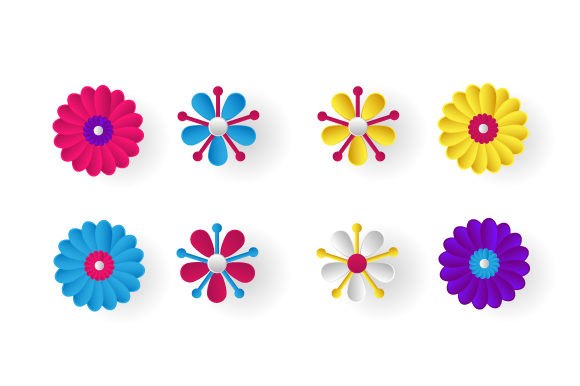
Realistic Flower Design Collection
Floral visuals carry weight—whether they’re anchoring a brand’s seasonal campaign, softening a tech company’s landing page, or adding tactile warmth to an educational ebook. But not all floral assets deliver authenticity. The Realistic Flower Design Collection stands apart because it prioritizes botanical fidelity over decorative abstraction: each element is built from high-resolution macro photography, layered vector interpretations, or carefully calibrated 3D renders—not stylized clipart or oversimplified icons. It’s not just about looking “pretty.” It’s about conveying texture, light interaction, petal translucency, and subtle imperfection—the kind you’d notice in a freshly cut ranunculus or a dew-laden lavender sprig.
What Sets This Collection Apart
Unlike many floral asset libraries that lean into illustration, watercolor washes, or flat design trends, the Realistic Flower Design Collection focuses on dimensional accuracy and material believability. Petals have visible veining; stamens cast micro-shadows; stems show slight taper and fibrous grain. These details aren’t ornamental—they serve functional roles in visual communication. A realistic peony bloom, for example, reads as luxury and craftsmanship in a boutique skincare launch; the same flower rendered in cartoonish outline would dilute that message.
The collection includes over 120 individual botanical elements—roses, dahlias, eucalyptus, cherry blossoms, foxgloves, and native wildflowers—each available in multiple formats: PNG with alpha transparency (for immediate layering), SVG (for responsive scaling without quality loss), and layered PSD files (for targeted color adjustment or shadow refinement). No placeholder gradients or auto-generated shadows. Every drop shadow is manually calibrated to match the light source implied by the original capture.
Practical Usability Across Workflows
For marketers building email headers or social ads, the Realistic Flower Design Collection reduces time spent sourcing, masking, and color-matching stock photos. Because each asset is isolated on transparent backgrounds and pre-optimized for web resolution (72–150 ppi), dropping them into Canva, Figma, or Adobe Express takes seconds—not hours. One freelance copywriter told us she uses the white lilac cluster as a recurring visual motif across client newsletters: it signals calm sophistication without requiring custom illustration each time.
Designers working in print face different demands—especially around color fidelity and bleed control. Here, the collection’s CMYK-verified EPS exports and Pantone-referenced swatch guides prove valuable. A small press publisher used the magnolia branch asset in a poetry chapbook cover; the matte paper stock picked up the subtle gray-green undertones in the leaves precisely because the file preserved LAB color space integrity during conversion.
Developers integrating floral accents into CMS-driven sites benefit from the SVG variants’ accessibility support: titles, descriptions, and semantic grouping are embedded in the code. That means screen readers can interpret a “field of poppies” background element as contextual decoration—not noise.
Consistency Without Uniformity
A common pitfall with floral asset packs is visual monotony: every rose looks identical in pose, lighting, and saturation. The Realistic Flower Design Collection avoids this by including multiple growth stages (buds, half-open, fully open) and environmental variations (sunlit vs. shaded, wind-tousled vs. still). A single tulip appears in three distinct orientations—side profile, front-facing, and low-angle—with matching leaf clusters that follow natural phyllotaxis patterns. This lets creators build scenes that feel curated, not templated.
Color flexibility is handled thoughtfully. Rather than offering dozens of pre-colored versions, the collection provides base neutral tones (ivory, slate, moss, charcoal) with clear guidance on safe hue-shift ranges—e.g., “roses respond well to +15° warmth in HSL without losing petal definition.” That empowers users to align assets with brand palettes while preserving realism.
Who Benefits Most—and When
Entrepreneurs launching lifestyle brands—think ceramic studios, organic tea lines, or handmade candle businesses—find immediate utility. A founder selling linen napkins used the flax flower asset to reinforce her “farm-to-table textile” narrative, pairing it with hand-lettered typography and unbleached paper textures. The floral element didn’t dominate—it grounded the messaging in tangible origin.
Educators creating science modules on plant morphology rely on the collection’s anatomical precision. One biology instructor replaced generic textbook diagrams with layered dahlia cross-sections from the set, allowing students to zoom into stamen arrangement or ovary structure without pixelation.
Freelance designers serving clients across industries appreciate the collection’s neutrality. It doesn’t scream “wedding” or “spa”—it adapts. A B2B SaaS team incorporated the fern frond motif into their sustainability report, using its organic geometry to symbolize growth and resilience without resorting to clichéd green arrows or leaf icons.
Limits Worth Noting
This isn’t a toolkit for motion graphics. While SVG files animate smoothly, the collection doesn’t include Lottie files, After Effects templates, or frame-by-frame sequences. If your project requires blooming animations or pollen drift effects, supplemental tools will be needed.
It also assumes baseline design literacy. There are no drag-and-drop website builders bundled in, nor step-by-step tutorials for beginners. Users should understand layer blending modes, mask application, and basic color theory to maximize the assets’ potential. That said, the included PDF guide offers concise, context-specific tips—like how to simulate backlighting on a hydrangea cluster using Multiply and Overlay layers—rather than generic software instructions.
Long-Term Value and Integration
Because the assets avoid trend-dependent styling—no neon glows, grunge overlays, or retro halftones—they age well. A 2022 brochure using the olive branch motif remains visually coherent alongside 2024 updates. That longevity matters for small businesses managing limited creative budgets: one purchase supports rebranding cycles, seasonal refreshes, and multi-channel consistency without repurchasing or redesigning.
Integration into existing systems is straightforward. All files follow standardized naming conventions (rose_crimson_full_bloom.png, eucalyptus_silver_grey_stem.svg), and metadata includes botanical names (Rosa damascena, Eucalyptus gunnii) for internal tagging or SEO alt-text drafting. A content strategist we spoke with uses the Latin names directly in image alt attributes—boosting relevance for niche search terms like “damask rose botanical illustration” without keyword stuffing.
Ultimately, the Realistic Flower Design Collection earns its place not by being exhaustive, but by being intentional. It fills a specific gap: the need for floral imagery that operates at the intersection of accuracy and adaptability—detailed enough for close inspection, flexible enough for rapid iteration, and restrained enough to serve serious professional goals. Whether you’re refining a product label, illustrating a research summary, or designing a quiet moment of visual breathing room on a dense webpage, these flowers don’t distract. They clarify.